Lec 20 · Cache Coherence: snoopy MSI·MESI·MOESI, false sharing, directory
정밀 정리 · 검증 2026-09-24 06:17
1개요
1.1ca_L13 p1~44: multiprocessor memory hierarchy(SMP·NUMA)와 bus, coherence 정의(SWMR·Data-Value invariant)
1.2snoopy cache 와 MSI protocol 예제, inclusive L2 snooping, MESI(Exclusive)·MOESI(Owned)로 bus traffic·write back 절감
1.3coherence miss(4C), false vs true sharing 예제, 상용 workload 성능 데이터
1.4snoopy 의 scalability 한계와 directory protocol(home·local·remote node, cache·directory state, read/write miss 흐름). p45~52 는 시간 부족으로 다음 강의로
2섹션별 정리 상황·문제 → 원인 → 해결
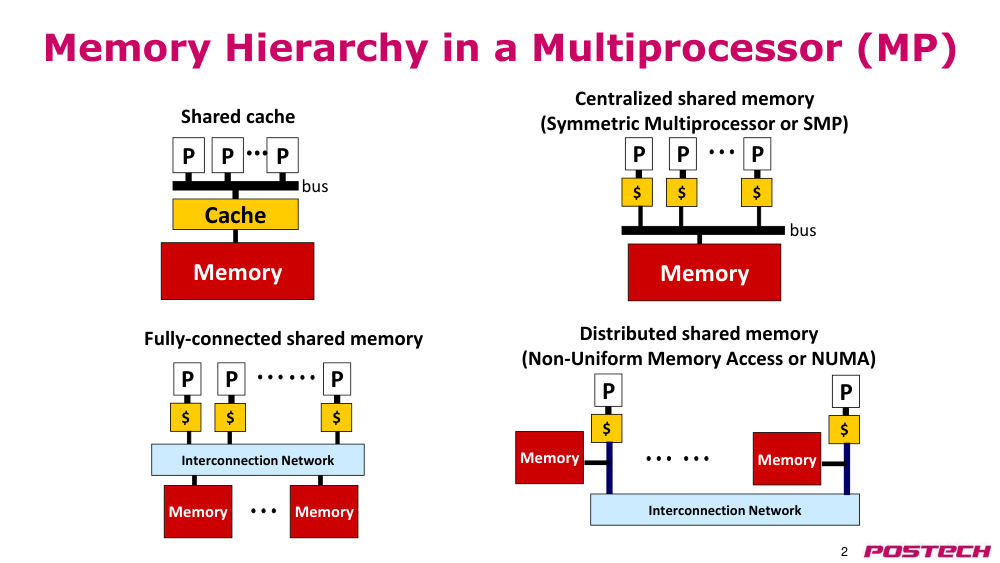
2.10:51–5:00Multiprocessor 의 memory hierarchy: shared cache, SMP, NUMA
상황·문제coherence 는 processor 가 여럿일 때만 생기는 문제. multiprocessor memory hierarchy 를 어떻게 구성하는가
원인processor 마다 전용 cache 를 두면 같은 data 의 복사본이 여러 cache 에 생긴다
해결SMP 는 bus/interconnect 뒤 단일 memory(모두 같은 latency), NUMA(distributed shared memory)는 node 별 local memory. 어느 쪽이든 cache 들이 최신 복사본을 보도록 통신이 필요
- shared cache: 여러 processor 가 하나의 cache 를 공유, LLC 뒤에 memory
- SMP: memory 가 모든 processor-cache 쌍에 대칭(같은 latency)
- NUMA: local memory 가 가장 빠르고 remote 는 node 거리만큼 느림
2.25:00–8:15Bus 동작: master·slave·arbiter
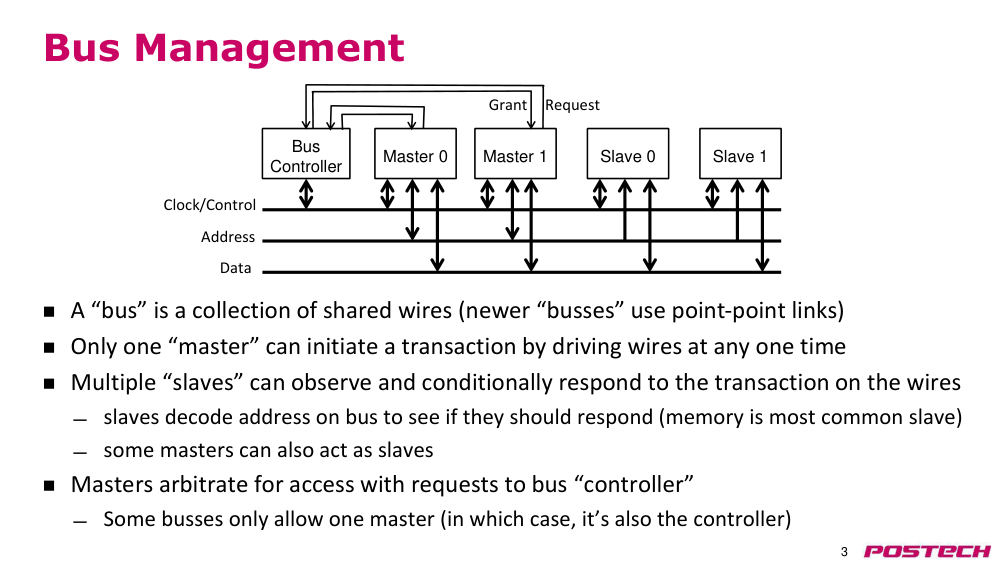
상황·문제cache 간 통신의 가장 단순한 수단인 bus 를 snoopy protocol 의 전제로 둔다
원인bus 는 공유 wire 묶음이라 한 번에 한 master 만 구동할 수 있다
해결master 가 controller(arbiter)에 request, grant 받으면 전송. slave 는 address 를 decode 해 응답 여부 결정. bus 로 cache·memory·I/O 를 연결
- bus 에 올린 data 는 연결된 모든 node 가 본다
- PCI Express 처럼 point-to-point link 도 bus 라 부르니 구분할 것
- 일부 master 는 다른 master 가 구동할 때 slave 로 동작
2.2.r.1Wikipedia: Bus snooping ↗ · snooper 가 bus transaction 을 감시, write-invalidate, broadcast 의 scalability 한계
2.38:15–13:09Coherence 정의: SWMR·Data-Value invariant, write propagation·serialization
상황·문제coherence 가 무엇인지 정의가 필요하다
원인같은 location 에 여러 core 가 read/write 하면 어떤 값을 봐야 하는지 불명확
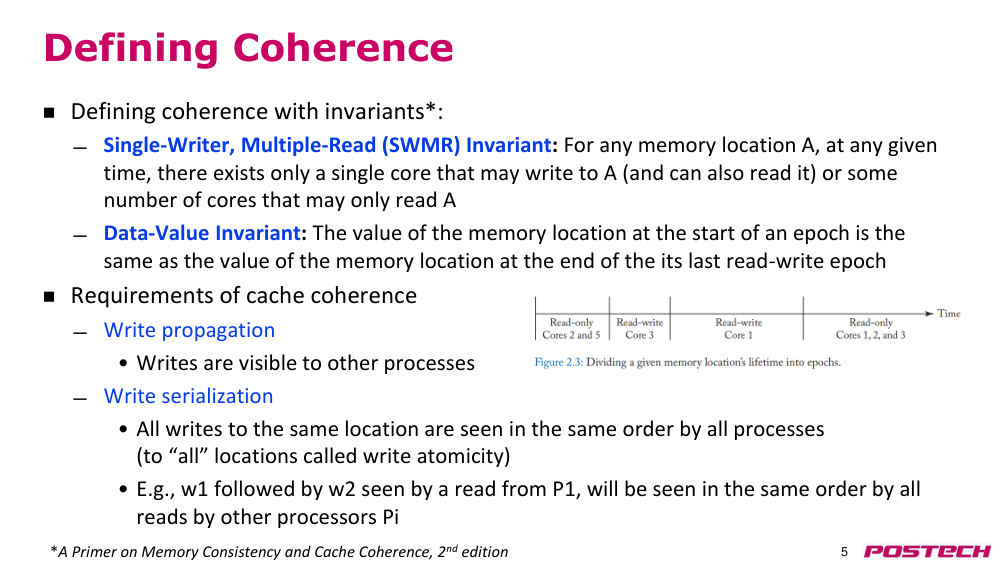
해결A Primer on Memory Consistency and Cache Coherence 의 두 invariant 로 정의. 구현 요건은 write propagation 과 write serialization
- SWMR: 어떤 시점에 한 location 은 single writer(읽기도 가능) 또는 여러 reader 만
- Data-Value: epoch 시작 값 = 마지막 read-write epoch 끝의 값 (epoch 는 그 location 기준)
- write serialization: W1 다음 W2 를 P1 이 보면 모든 processor 가 같은 순서로 봐야 함
2.3.r.1Sorin·Hill·Wood, A Primer on Memory Consistency and Cache Coherence (1판, UCLA 강의 사본) ↗ · p5 의 SWMR·Data-Value invariant 원문 (슬라이드는 2판 인용, 정의 문구 동일)
2.3.r.2Wikipedia: Cache coherence ↗ · coherence 정의, write propagation·transaction serialization, snooping vs directory 개요
2.413:09–15:18Snoopy cache (Goodman 1983)
상황·문제coherence 구현 방식은 크게 둘, 먼저 snooping
원인각 cache 가 다른 cache 의 bus transaction 을 알아야 올바르게 반응할 수 있다
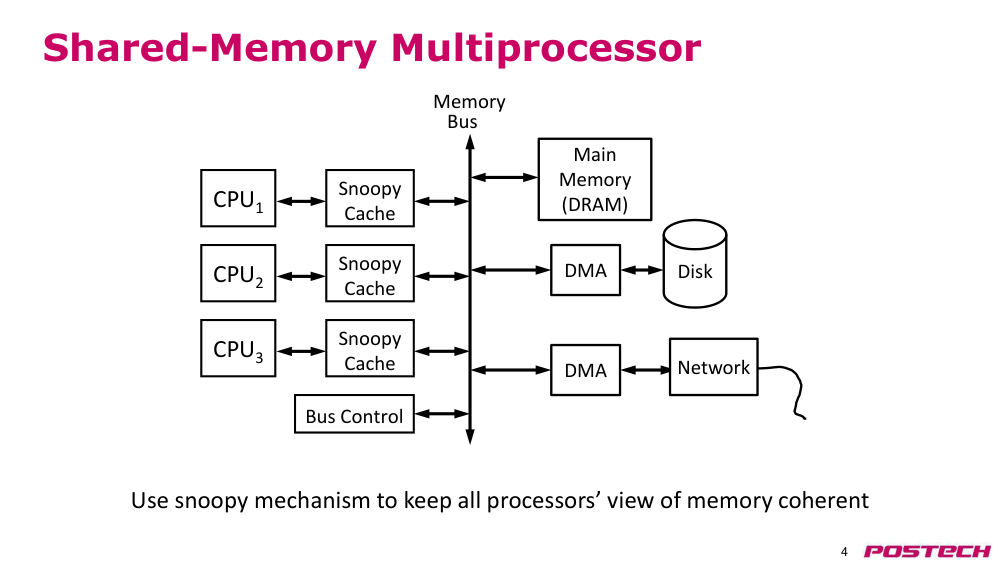
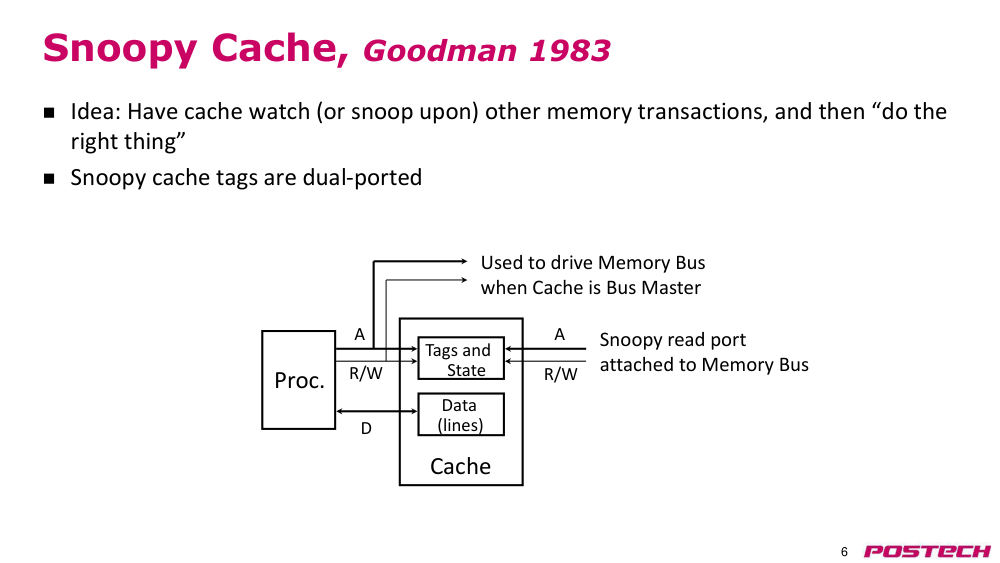
해결참여하는 모든 cache 가 bus 의 모든 transaction 을 관찰하고 line state 에 따라 '올바른 일' 수행. processor 접근과 snoop 을 동시에 하려고 tag 를 dual-ported 로
- tag port 하나는 processor demand access, 다른 하나는 bus snoop 용
- 필요하면 cache 가 bus 에 신호를 올려 protocol 을 수행
2.4.r.1Goodman, RETROSPECTIVE: Using Cache Memory to Reduce Processor-Memory Traffic (UW-Madison) ↗ · p6 제목의 Goodman 1983 snoopy cache 논문에 대한 저자 회고
2.4.r.2Wikipedia: Bus snooping ↗ · snooper 가 bus transaction 을 감시, write-invalidate, broadcast 의 scalability 한계
2.515:18–19:36MSI protocol 의 state 와 intervention
상황·문제cache block 마다 어떤 state 를 두어 SWMR 을 지킬 것인가
원인write-back cache 에서 M 인 line 이 있으면 memory 는 stale data 를 가진다
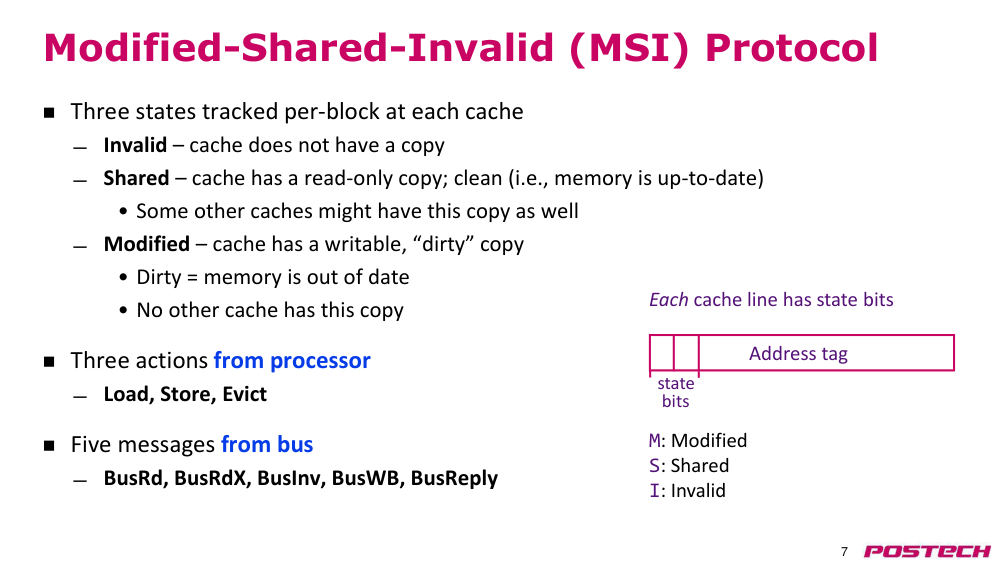
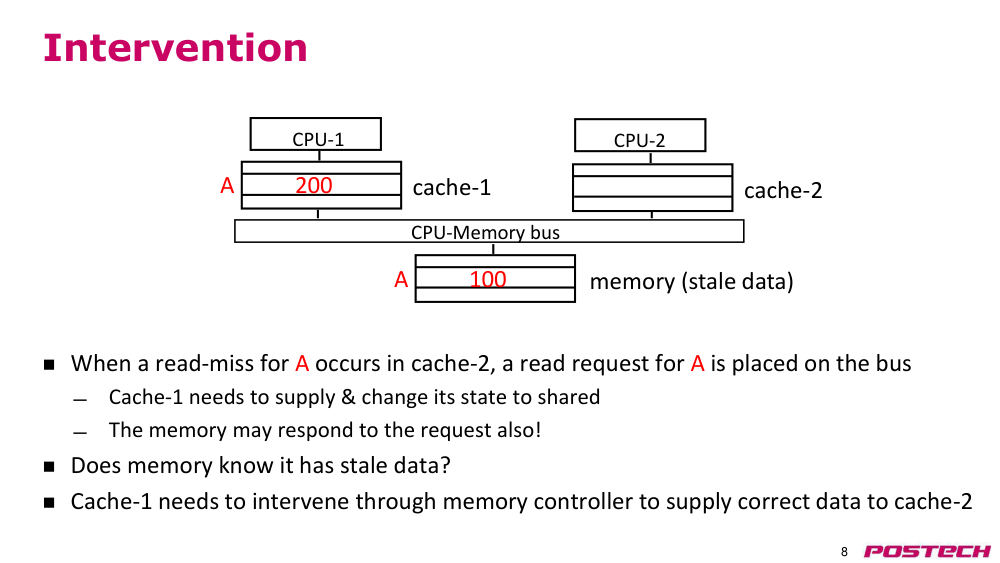
해결I(복사본 없음)·S(read-only, clean, 다른 cache 에도 있을 수 있음)·M(writable, dirty, 유일한 복사본) 을 tag 의 2 bit 로. dirty 복사본을 가진 cache 가 BusRd 에 intervention 해 응답
- processor action 3개: Load, Store, Evict
- bus message 5개: BusRd, BusRdX, BusInv, BusWB, BusReply
- intervention 없으면 memory 가 stale data 로 응답
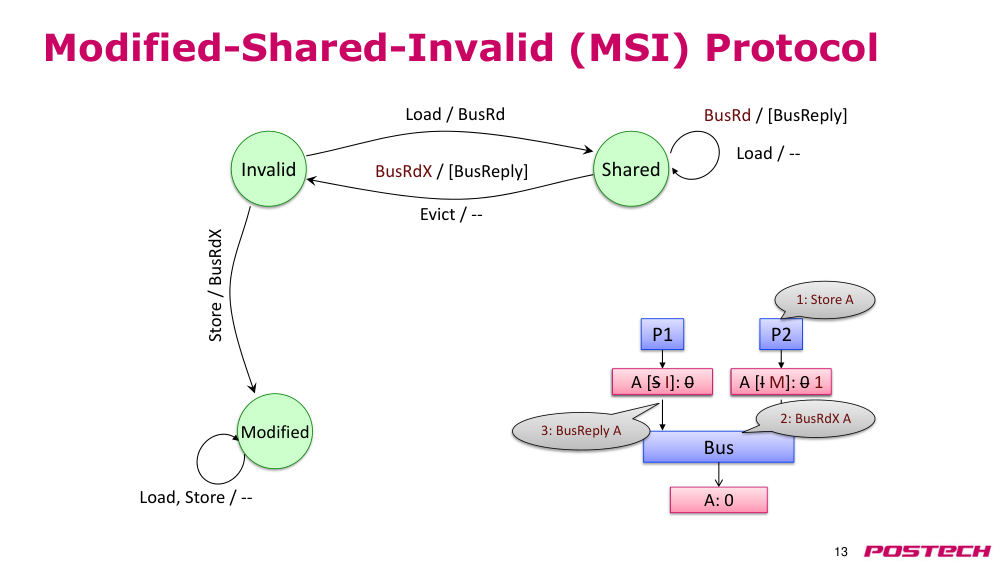
2.619:36–25:02MSI 예제: P1·P2 가 A 를 load·store·evict
상황·문제MSI 가 실제 access 순서에서 어떤 message 와 전이를 만드는지 단계별로 본다
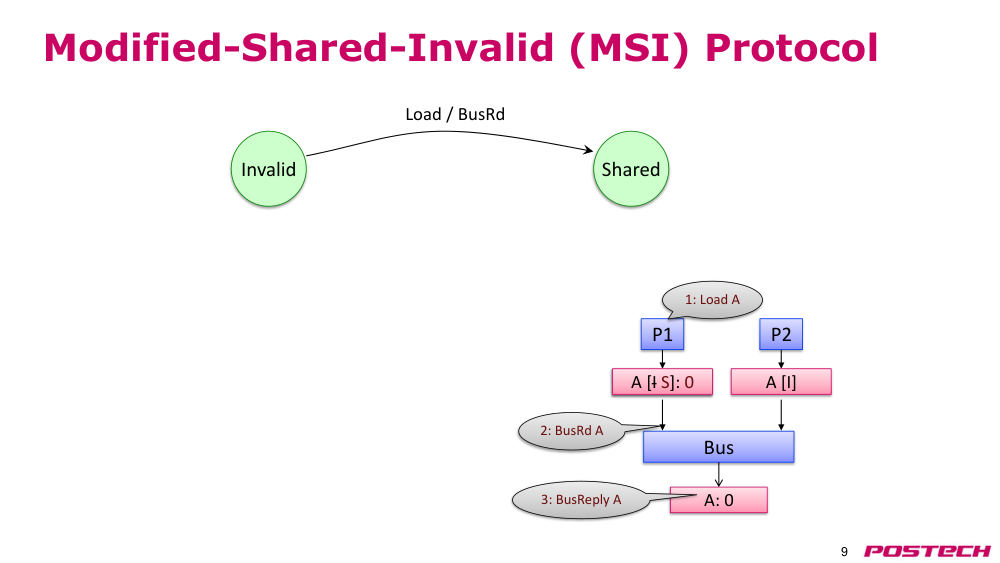
원인state 에 따라 필요한 bus message 가 다르다 (S hit 는 message 없음, S→M 은 invalidate 필요)
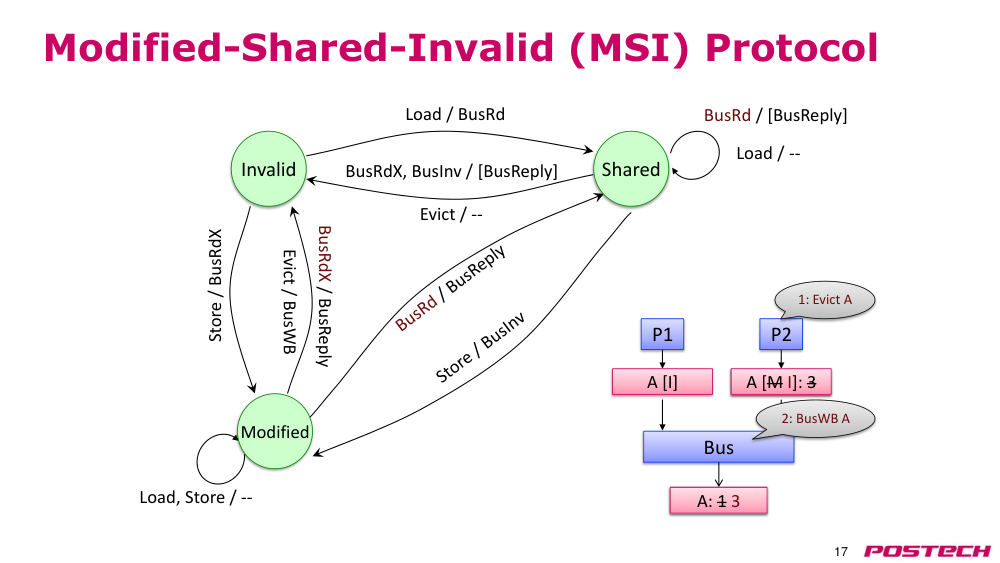
해결load miss 는 BusRd, I 에서 store 는 BusRdX, S 에서 store 는 BusInv, M 이 BusRd 받으면 BusReply 후 S 가 되고 memory 갱신, M evict 는 BusWB
- S line evict 는 message 없이 I
- M→S 로 공유될 때 S 는 clean 이어야 하므로 memory 도 update
- P2 가 M 인 line 을 evict 할 때 BusWB 로 memory(A=3) 갱신
2.725:02–28:33MSI state diagram 분리와 inclusive L2 snooping
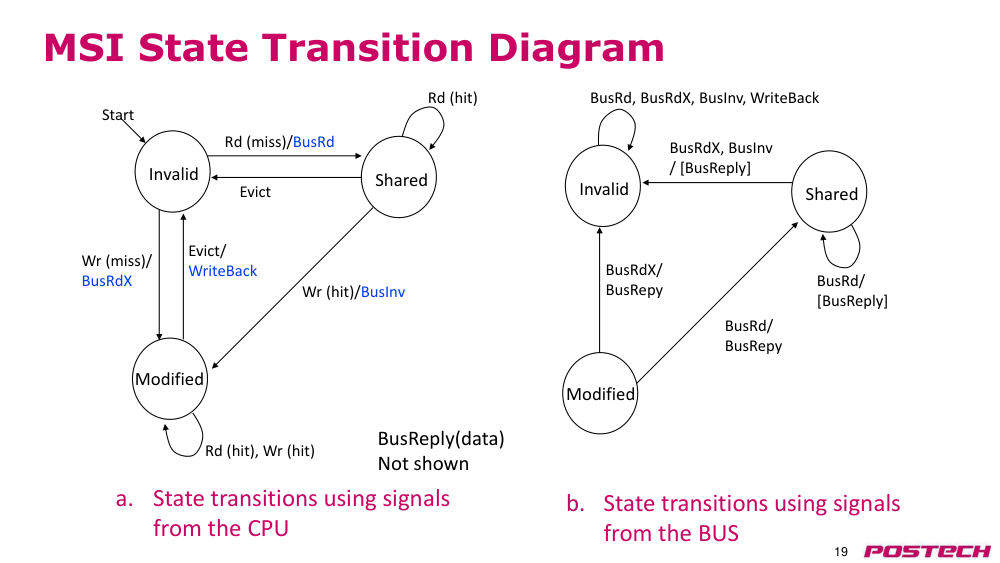
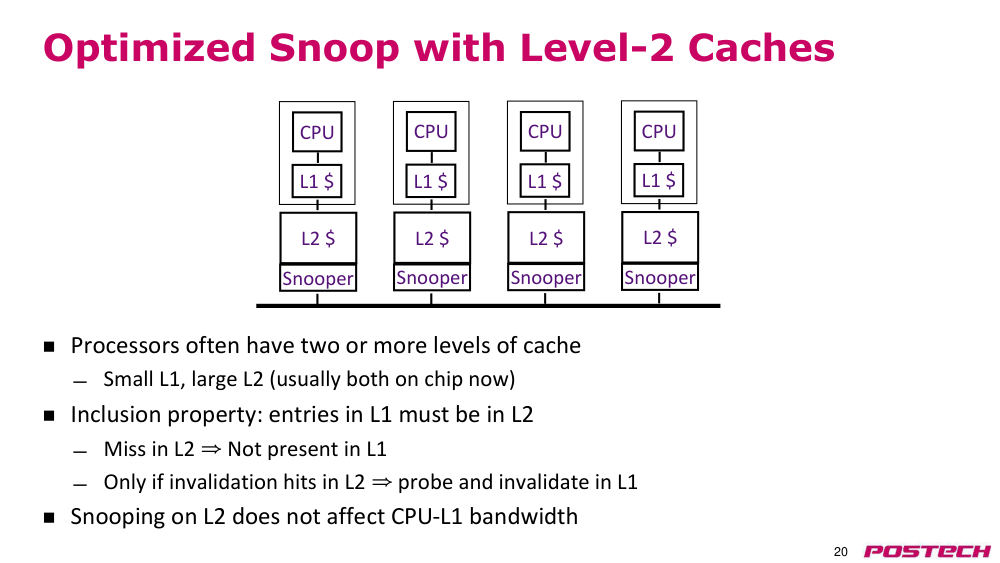
상황·문제snoop 이 L1 까지 매번 확인하면 processor 의 L1 접근을 방해한다
원인multi-level cache 에서 bus message 마다 어느 level 에 line 이 있는지 알아야 함
해결L2 를 L1 의 inclusive 로 두면 L2 tag 만 snoop: L2 miss 면 L1 에도 없음, L2 invalidation hit 일 때만 L1 probe·invalidate
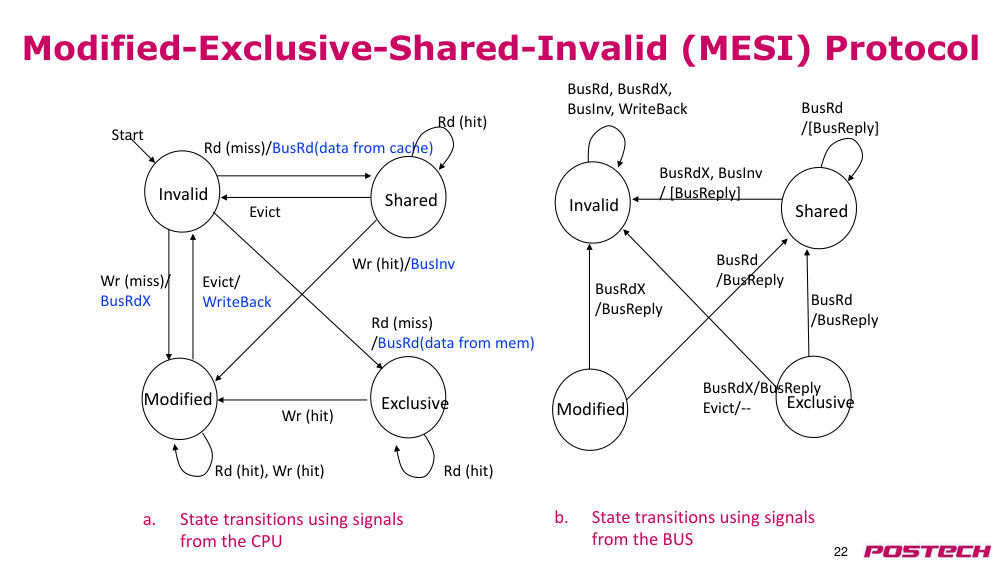
- state diagram 을 CPU 신호(read/write/evict)와 bus 신호로 나눠 그림
- exclusive L2 면 L2 miss 마다 L1 tag 를 보거나 L1 tag 사본을 L2 에 둬야 함
2.828:33–35:07MESI protocol: Exclusive state 로 read-upgrade overhead 제거
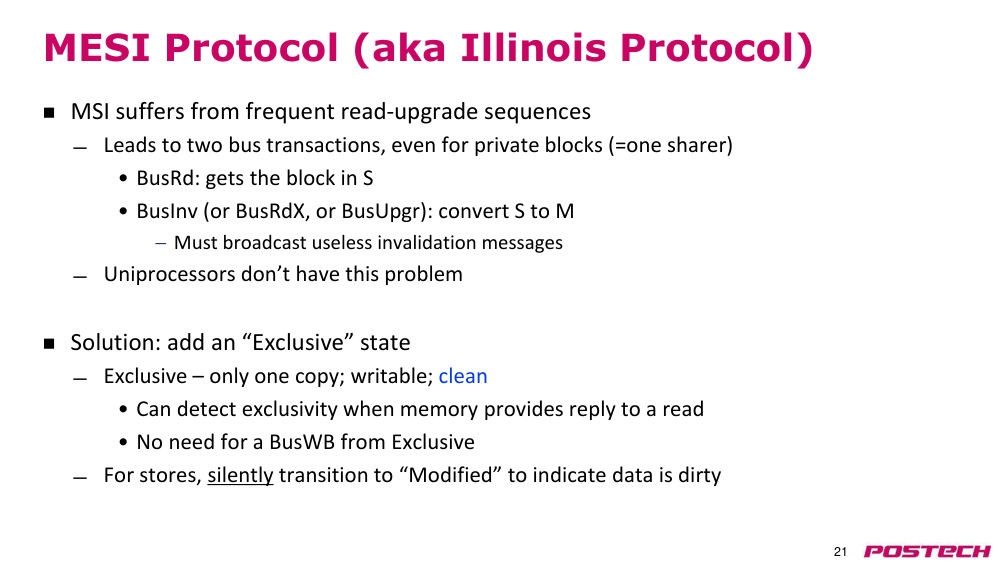
상황·문제read 후 write(예: 메모리 값 increment)가 흔한데 MSI 는 S 로 가져온 뒤 BusInv 를 또 보낸다
원인MSI 는 자기만 복사본을 가진 private block 인지 알 수 없어 쓸모없는 invalidation 을 broadcast. uniprocessor 에는 없는 overhead
해결E(유일한 clean 복사본) 추가. BusRd 응답이 memory 에서 오면 E, cache 에서 오면 S. E 에서 write 는 message 없이 M 으로 silent upgrade
- E 에서 다른 cache 의 BusRd → reply 후 S
- E 에서 BusRdX → reply 후 I, evict → I
- Illinois protocol 이라고도 함 (슬라이드 제목)
2.8.r.1Wikipedia: MESI protocol ↗ · Exclusive state, Illinois protocol, E→M silent upgrade(bus transaction 없음)
2.935:07–41:12Owned state: M 을 공유할 때 memory write back 회피 (+ ROM 질문)
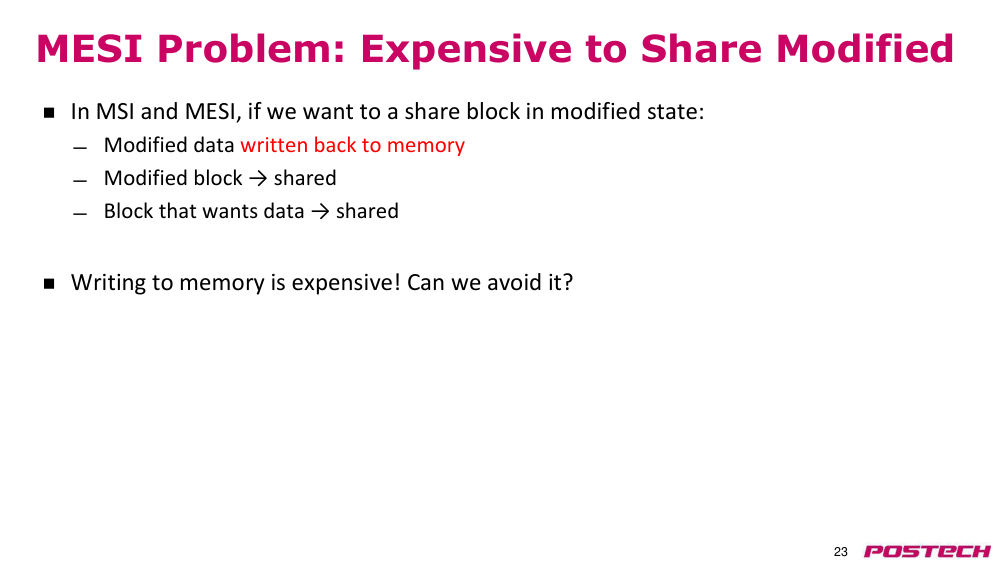
상황·문제MSI·MESI 에서 M→S 로 공유하면 dirty data 를 memory 에 write back 해야 한다
원인S 는 clean 을 보장해야 하는데, 곧 다른 cache 가 다시 수정할 수도 있어 비싼 memory update 가 낭비
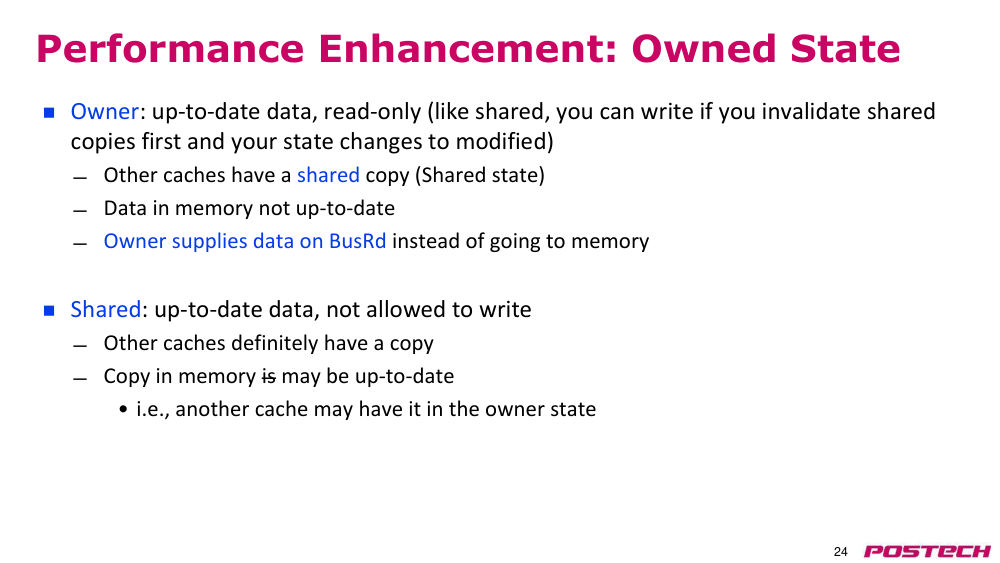
해결O(owned) 추가: 최신·read-only 지만 dirty. 다른 cache 는 S 로 공유, BusRd 에는 owner 가 data 공급, owner 가 evict 할 때만 memory 에 write back
- O 가 있으면 S 의 의미가 바뀜: memory 가 최신이 아닐 수 있음
- S 복사본은 message 없이 로컬 invalidate 가능
- Q&A: 특정 주소를 read-only 로 캐시? — virtual memory 의 read-only page 로 처리 가능 (강의자 답)
2.9.r.1Wikipedia: MOESI protocol ↗ · Owned state: dirty 이면서 공유 가능, owner 가 snoop 에 data 응답·memory 갱신 책임
2.1041:12–46:04MOESI: 허용 state 조합, 전이, state bit
상황·문제Owned 추가 후 cache 쌍마다 어떤 state 조합이 가능하고 어떻게 전이하는가
원인M·E 는 유일한 복사본, O 는 S 들과만 공존해야 한다
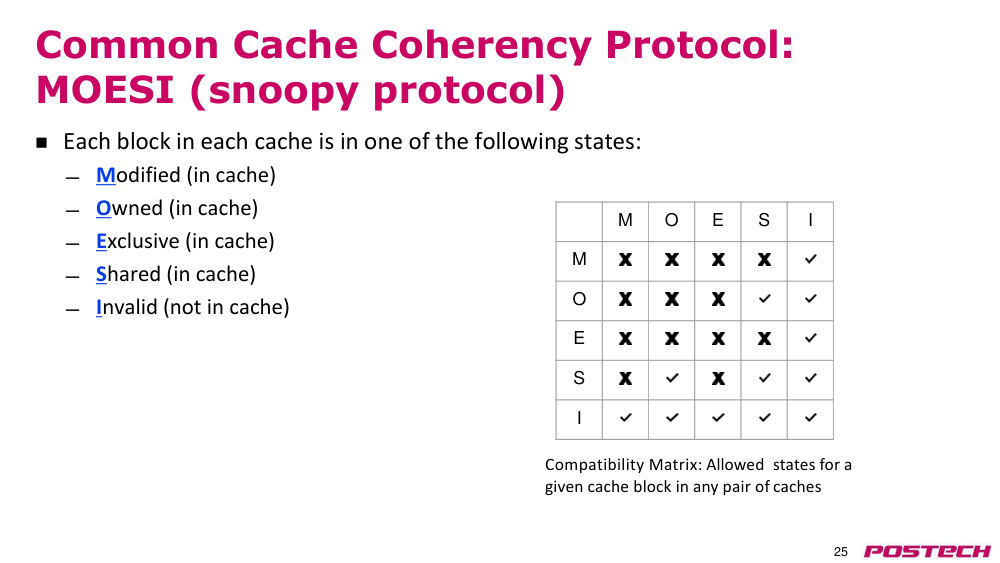
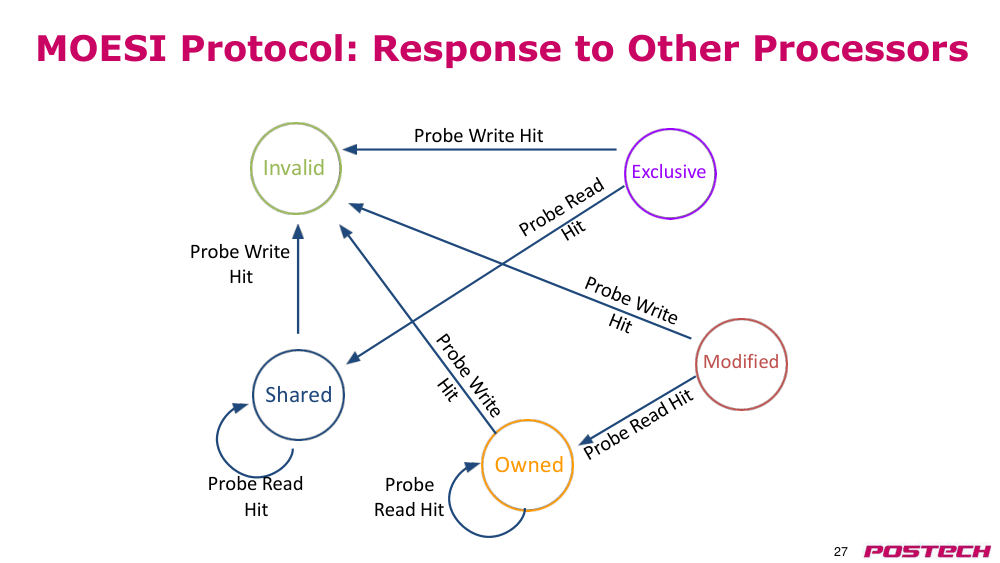
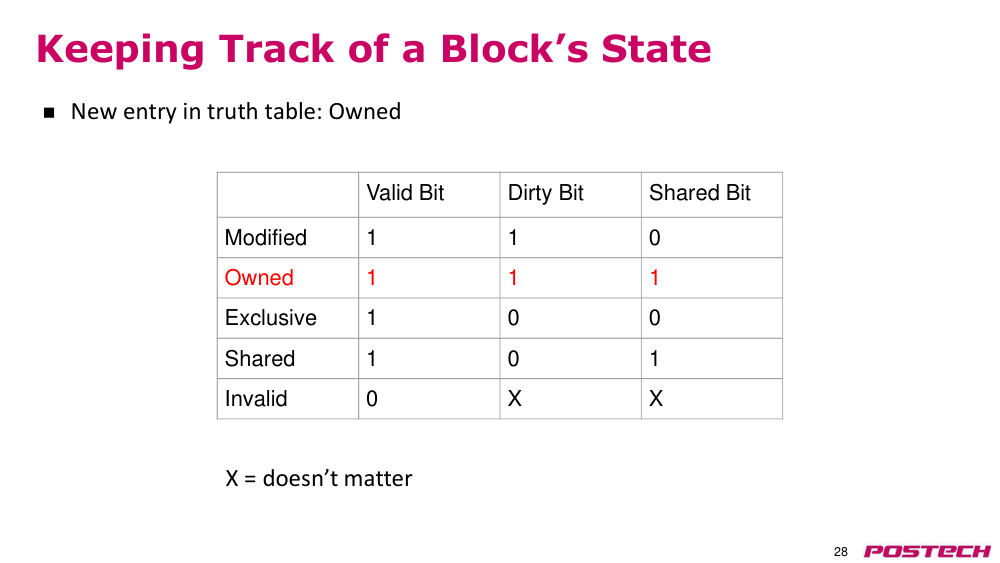
해결compatibility matrix 로 조합 정리, processor action 만으로는 O 로 가지 않고 M 이 다른 cache 의 BusRd(probe read hit)를 받을 때 O 로 전이. valid·dirty·shared 3 bit 로 표현
- M: 다른 cache 는 I 만, O: 다른 cache 는 S·I, S: 다른 cache 는 O·S·I
- M 에서 probe write hit(BusRdX) → I
- O 는 valid·dirty·shared bit 가 모두 1
2.10.r.1Wikipedia: MOESI protocol ↗ · Owned state: dirty 이면서 공유 가능, owner 가 snoop 에 data 응답·memory 갱신 책임
2.1146:04–51:00Coherence miss(4번째 C)와 false sharing
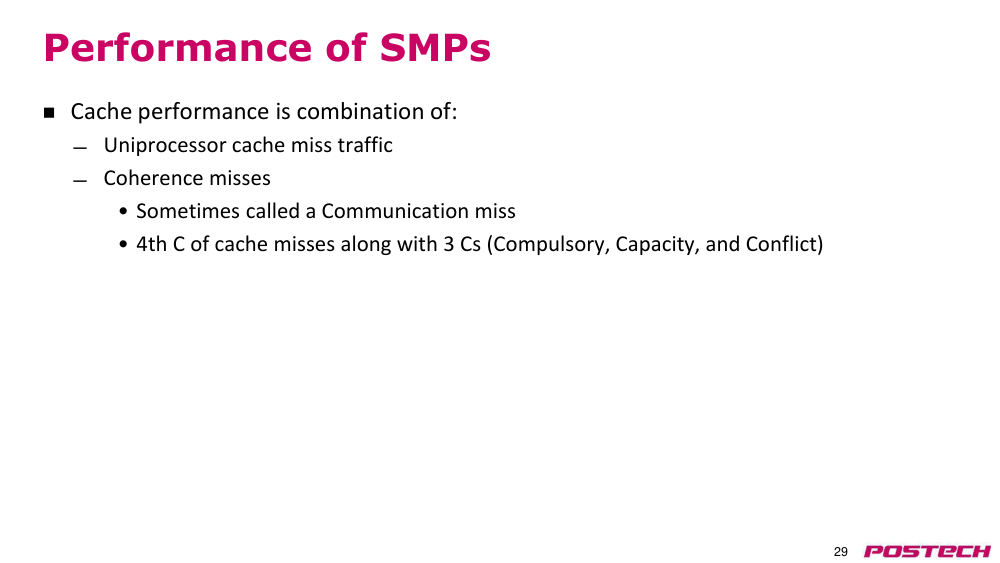
상황·문제coherence protocol 이 invalidate 한 line 을 다시 접근하면 새 유형의 miss 가 생긴다
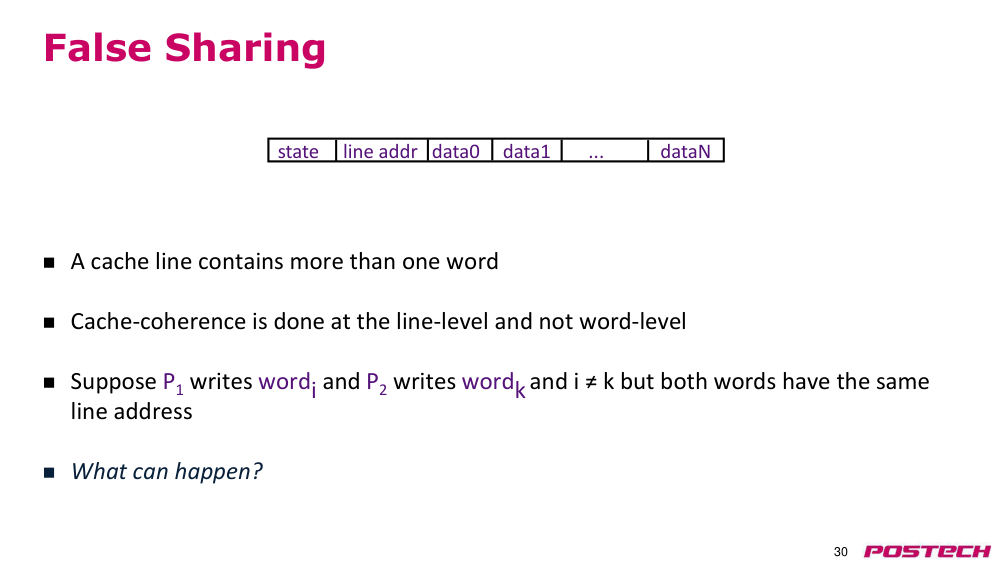
원인coherence 가 word 가 아닌 cache line 단위라, 다른 word 를 쓰는 processor 끼리도 line 이 ping-pong
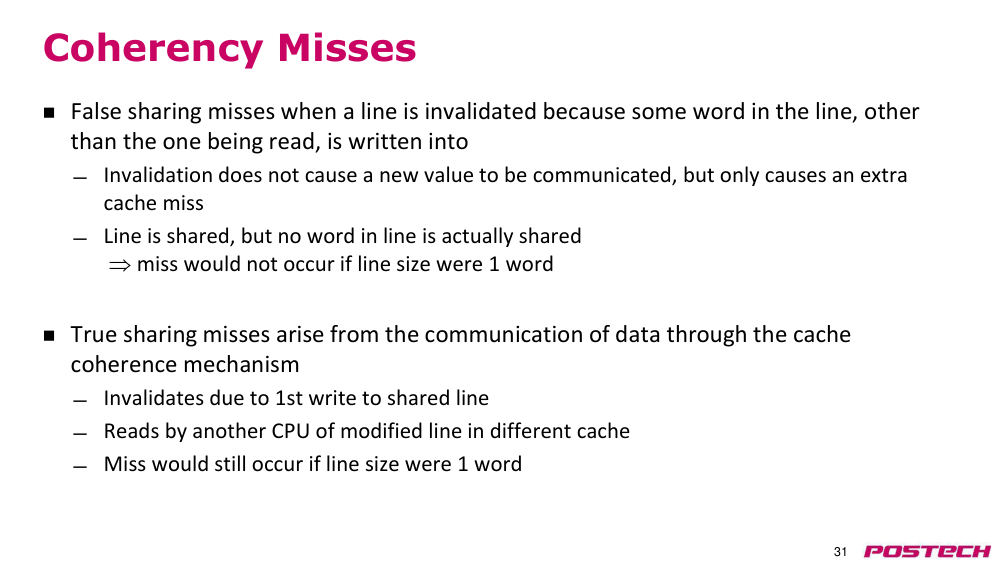
해결compulsory·capacity·conflict 에 coherence miss 를 더해 4C. 실제 data 통신 때문인 true sharing 과 구분
- false sharing miss: line 은 공유되나 word 는 공유 안 됨, line 이 1 word 면 사라짐 (하지만 너무 비쌈)
- true sharing miss: processor 간 실제 통신, line 이 1 word 여도 발생
2.11.r.1Wikipedia: False sharing ↗ · 같은 cache line 의 서로 다른 data 를 쓰는 thread 들 사이의 coherence traffic 예
2.1251:00–58:40예제: true vs false sharing miss 판별
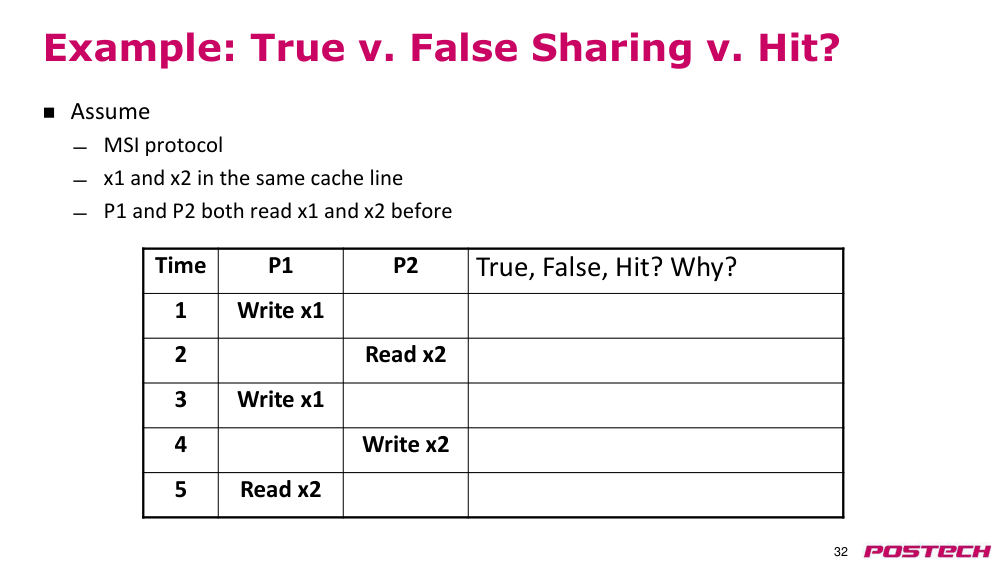
상황·문제MSI, x1·x2 같은 line, P1·P2 모두 S 상태에서 5 개 access 의 miss 종류를 판정
원인판정 기준: 다른 processor 가 다른 word 에 접근하지 않았어도 이 miss 가 났을까
해결1 Write x1 true(S→M invalidate 는 피할 수 없음), 2 Read x2 false, 3 Write x1 false, 4 Write x2 true, 5 Read x2 true
- 2: P1 이 x1 을 쓴 invalidation 때문에 P2 가 x2 read miss → false
- 3: P2 가 x2 를 읽지 않았다면 P1 은 M 을 유지했을 것 → false
- 5: P2 가 쓴 x2 를 P1 이 읽는 실제 통신 → true
2.12.r.1Wikipedia: False sharing ↗ · 같은 cache line 의 서로 다른 data 를 쓰는 thread 들 사이의 coherence traffic 예
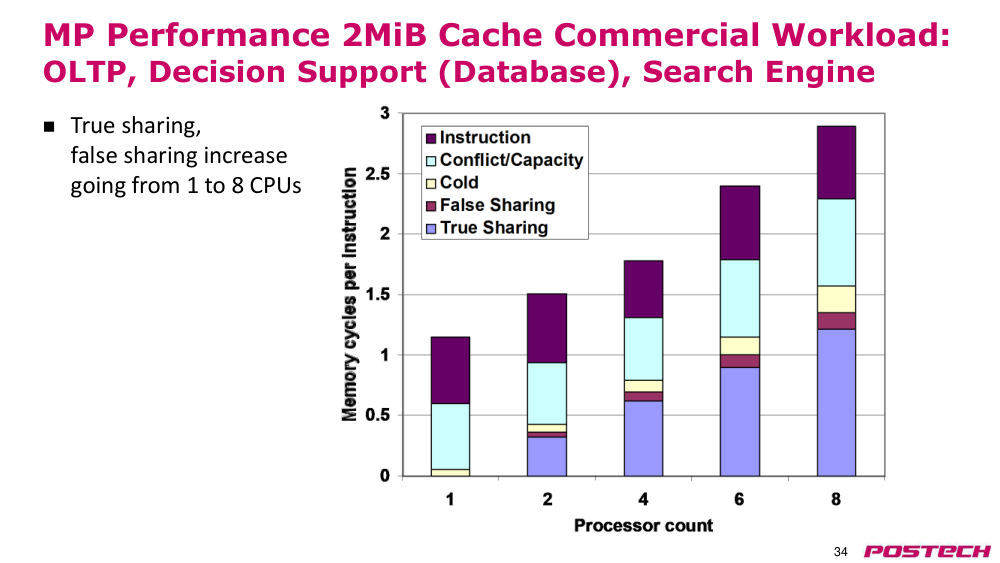
2.1358:40–1:00:34SMP 성능 데이터: cache size·processor 수와 coherence miss
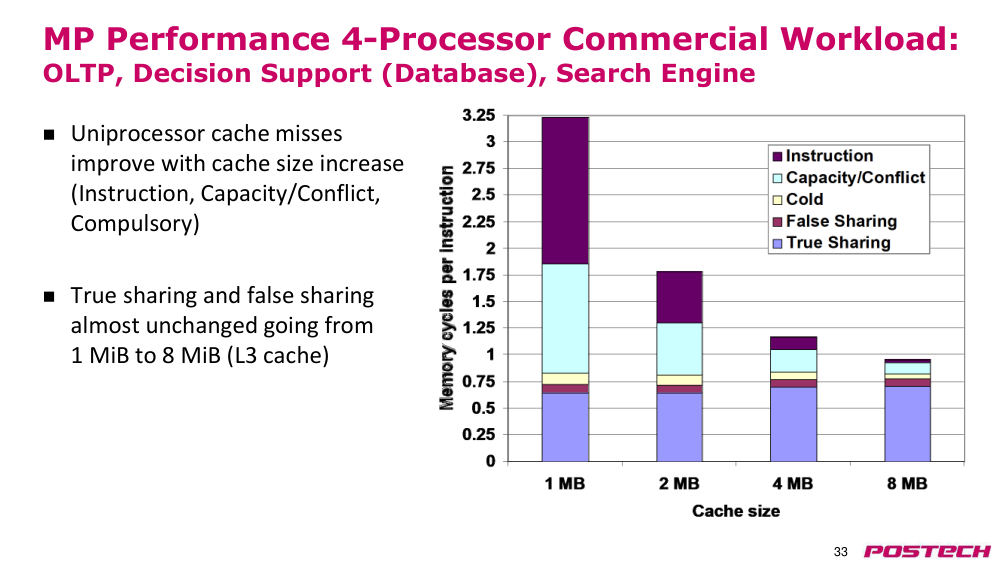
상황·문제coherence miss 가 실제 workload(OLTP, decision support, search engine)에서 얼마나 중요한가
원인coherence miss 는 다른 processor 의 활동 때문에 생겨 cache size 에 거의 영향 받지 않는다
해결4-processor 에서 L3 1→8 MiB 로 키우면 uniprocessor miss 는 줄지만 true/false sharing 은 거의 그대로. 2 MiB 고정에 CPU 1→8 개면 sharing miss 증가
- coherence miss 비중은 processor 수가 늘수록 커짐
- 이 데이터에서는 작지만 경우에 따라 문제
2.13.r.1Hennessy & Patterson, Computer Architecture: A Quantitative Approach 6th ed. (Elsevier) ↗ · p52 추천 독서 Chapter 5 Multiprocessors and Thread-Level Parallelism
2.141:00:34–1:05:11Snoopy 의 scalability 한계와 directory 도입
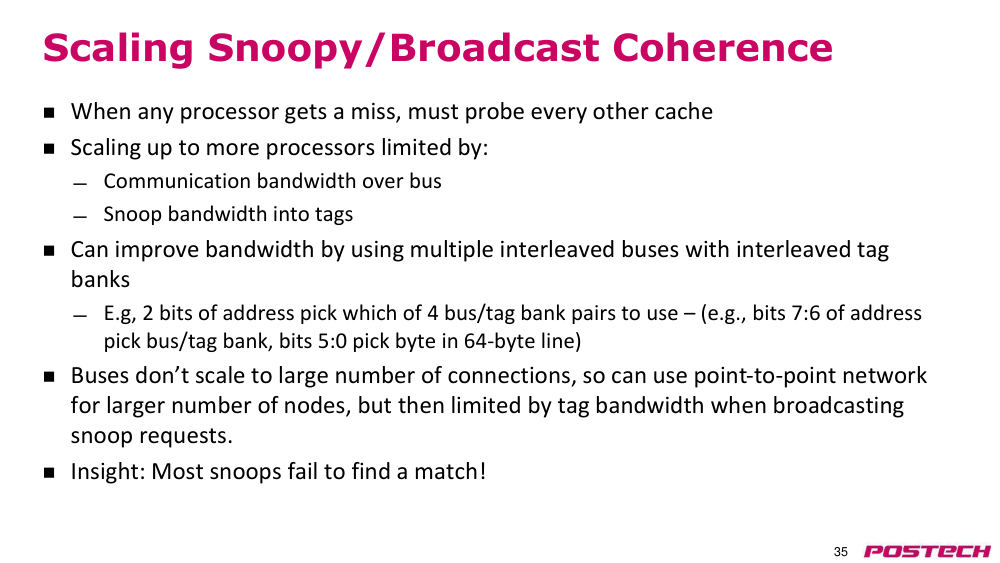
상황·문제snoopy 는 4개, 늘려도 8개 정도 processor 에서만 잘 동작. 64·1024 개면 비용이 너무 크다
원인모든 miss 가 broadcast 되어 bus bandwidth 와 tag snoop bandwidth 가 병목, 대부분 snoop 은 match 가 없음
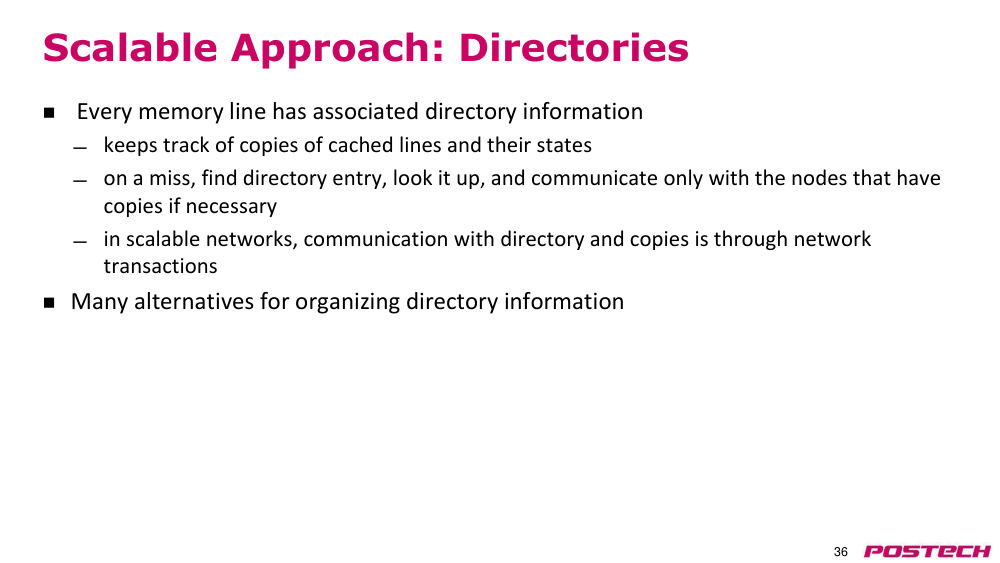
해결interleaved bus·tag bank 는 부분 해결일 뿐. directory 가 line 별 복사본 위치·state 를 추적해 관련 node 에만 message, 대신 scalable network 필요
- point-to-point network 로 bus bandwidth 는 풀어도 broadcast 면 tag bandwidth 문제 남음
- 예: address bit 7:6 으로 4 개 bus/tag bank 선택, bit 5:0 은 64-byte line 내 byte
- snoopy 에서는 아무도 다른 cache 의 line state 를 모름 → directory 가 보관
2.14.r.1Wikipedia: Bus snooping ↗ · snooper 가 bus transaction 을 감시, write-invalidate, broadcast 의 scalability 한계
2.14.r.2Wikipedia: Directory-based cache coherence ↗ · cache line 마다 processor 별 bit vector(sharer set)를 두는 directory 형식
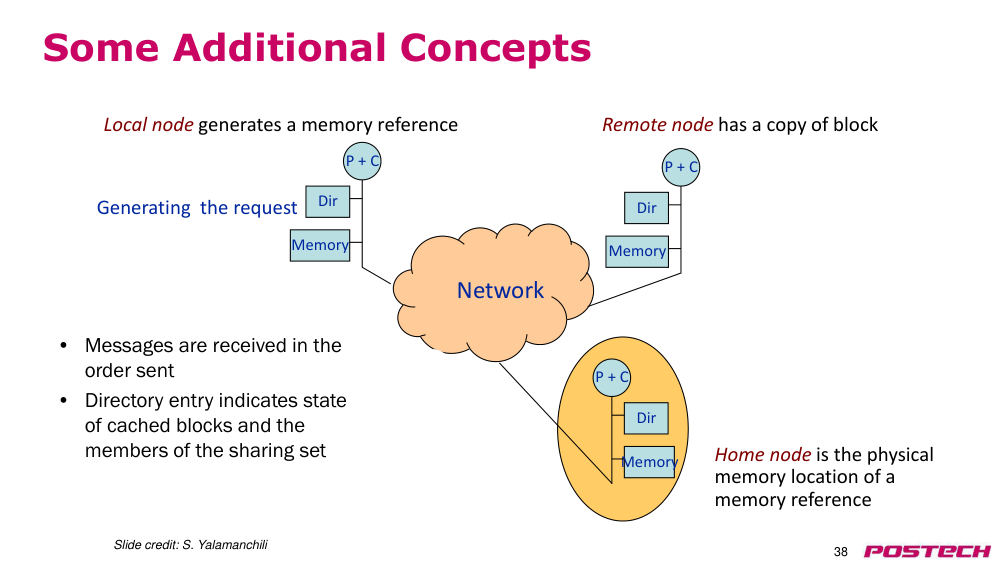
2.151:05:11–1:16:48Directory protocol: node 역할, cache·directory state, read/write miss 흐름
상황·문제directory 기반에서 miss 를 어떻게 처리하는가
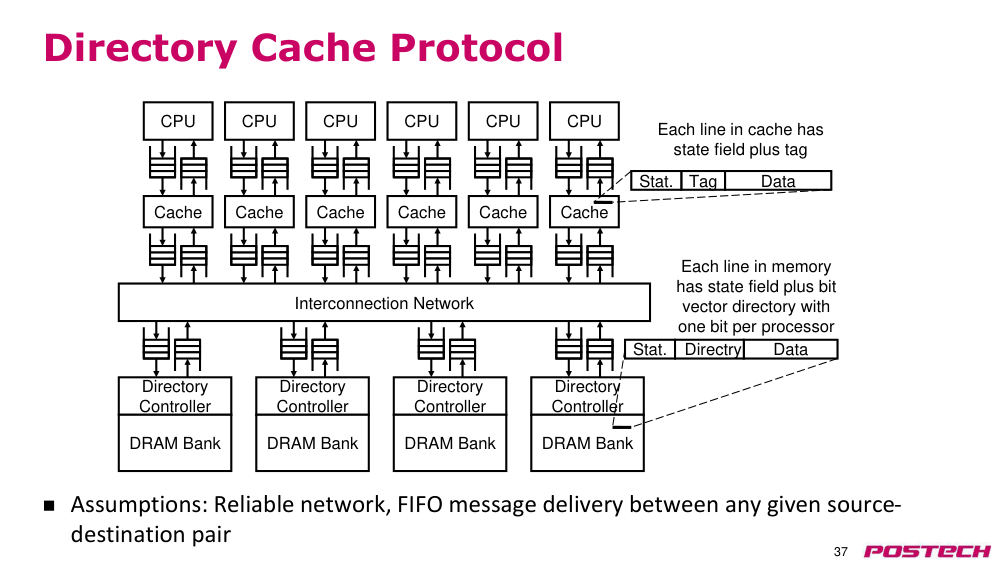
원인주소마다 담당 directory controller(home)가 있고, 실제 복사본은 다른 node 에 있을 수 있다. 전이 중간 상태가 생긴다
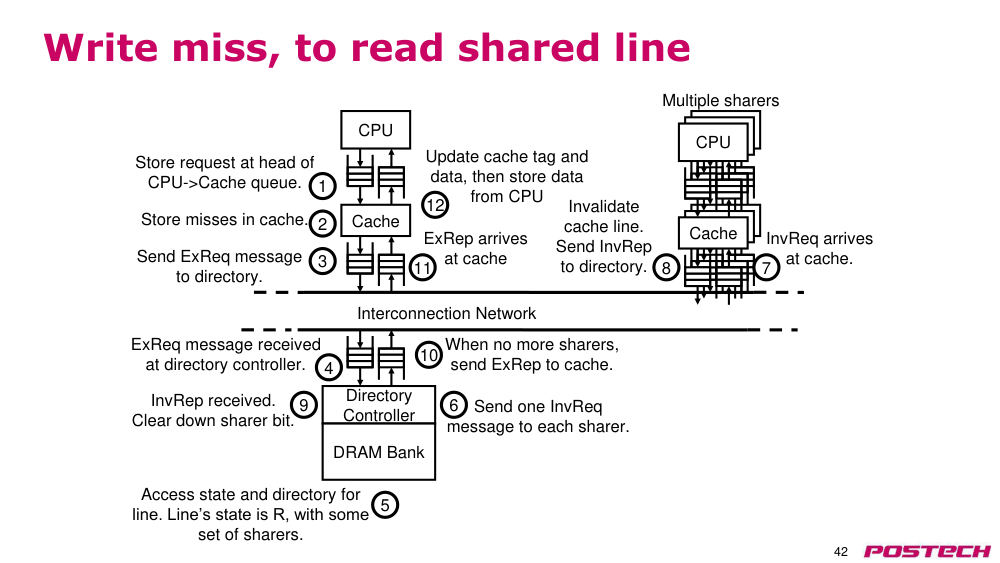
해결miss 는 주소의 home directory 로 요청 → sharer bit vector 보고 필요한 node 에만 message. read miss 는 ShReq/ShRep, write miss 는 ExReq → sharer 에 InvReq → InvRep 모두 받으면 ExRep
- reliable network, source-destination 쌍별 FIFO delivery 가정
- local(요청) / remote(복사본 보유) / home(주소 담당 memory) node
- cache: C-invalid·C-shared·C-modified·C-transient, home: R(dir)·W(id)·TR(dir)·TW(id). transient state 가 많아 검증이 어려움
- 시간 부족으로 p45 이후는 다음 강의로
2.15.r.1Wikipedia: Directory-based cache coherence ↗ · cache line 마다 processor 별 bit vector(sharer set)를 두는 directory 형식
3핵심 개념
3.1NUMA(non-uniform memory access)
node 마다 local memory, remote memory 는 거리만큼 latency 가 김
3.2SWMR invariant(single-writer multiple-reader)
한 시점·한 location 에 writer 하나(읽기도 가능) 또는 reader 여럿만
3.2.r.1Sorin·Hill·Wood, A Primer on Memory Consistency and Cache Coherence (1판, UCLA 강의 사본) ↗ · p5 의 SWMR·Data-Value invariant 원문 (슬라이드는 2판 인용, 정의 문구 동일)
3.3Data-Value invariant
epoch 시작 값 = 마지막 read-write epoch 끝의 값
3.3.r.1Sorin·Hill·Wood, A Primer on Memory Consistency and Cache Coherence (1판, UCLA 강의 사본) ↗ · p5 의 SWMR·Data-Value invariant 원문 (슬라이드는 2판 인용, 정의 문구 동일)
3.4write serialization(쓰기 직렬화)
같은 location 에 대한 write 들을 모든 processor 가 같은 순서로 본다
3.4.r.1Wikipedia: Cache coherence ↗ · coherence 정의, write propagation·transaction serialization, snooping vs directory 개요
3.5snoopy cache(스누피 캐시)
모든 cache 가 bus transaction 을 관찰하고 state 에 따라 반응, tag 는 dual-ported
3.5.r.1Wikipedia: Bus snooping ↗ · snooper 가 bus transaction 을 감시, write-invalidate, broadcast 의 scalability 한계
3.6intervention(개입)
dirty 복사본을 가진 cache 가 memory 대신 BusRd 에 응답해 stale data 를 막음
3.7MSI protocol
Invalid·Shared(clean, read-only)·Modified(dirty, 유일) 3 state
3.8inclusion property(포함 속성)
L1 항목이 모두 L2 에 있음 → L2 만 snoop, L2 miss 면 L1 에도 없음
3.9Exclusive state(MESI)
유일한 clean 복사본, write 시 message 없이 M 으로 silent upgrade
3.9.r.1Wikipedia: MESI protocol ↗ · Exclusive state, Illinois protocol, E→M silent upgrade(bus transaction 없음)
3.10Owned state(MOESI)
최신·read-only·dirty, 다른 cache 는 S, owner 가 BusRd 응답과 evict 시 write back 책임
3.10.r.1Wikipedia: MOESI protocol ↗ · Owned state: dirty 이면서 공유 가능, owner 가 snoop 에 data 응답·memory 갱신 책임
3.11coherence miss(4번째 C)
다른 processor 의 invalidation 때문에 생기는 miss, communication miss 라고도 함
3.12false sharing(거짓 공유)
같은 line 의 다른 word 를 쓰는 processor 끼리 line 이 ping-pong 하며 생기는 miss
3.12.r.1Wikipedia: False sharing ↗ · 같은 cache line 의 서로 다른 data 를 쓰는 thread 들 사이의 coherence traffic 예
3.13true sharing(진짜 공유)
processor 간 실제 data 통신 때문의 miss, line 이 1 word 여도 발생
3.14directory(디렉터리)
line 별 state 와 sharer bit vector 를 두어 broadcast 대신 관련 node 에만 message
3.14.r.1Wikipedia: Directory-based cache coherence ↗ · cache line 마다 processor 별 bit vector(sharer set)를 두는 directory 형식
3.15home / local / remote node
home 은 주소를 담당하는 memory·directory, local 은 요청자, remote 는 복사본 보유 node
3.16transient state(과도 상태)
요청을 보내고 응답을 기다리는 중간 state, 많을수록 protocol 구현·검증이 어려움
4스스로 확인
4.1SMP 와 NUMA 에서 memory latency 는 어떻게 다른가?
답
SMP 는 모든 processor 가 같은 latency, NUMA 는 local memory 가 빠르고 remote 는 node 거리만큼 느리다
4.2snoopy cache 의 tag 가 dual-ported 여야 하는 이유는?
답
processor demand access 와 bus snoop 을 동시에 tag 에서 처리해야 하기 때문
4.3MSI 에서 M 인 line 에 다른 cache 가 BusRd 를 보내면 무슨 일이 일어나는가?
답
M cache 가 intervention 해 BusReply, 둘 다 S 가 되고 S 는 clean 이어야 하므로 memory 도 갱신
4.4MESI 에서 BusRd 후 E 와 S 중 어디로 갈지 어떻게 정하나?
답
응답이 memory 에서 오면 다른 복사본이 없으므로 E, 다른 cache 에서 오면 S
4.5Owned state 가 줄여 주는 비용은?
답
M block 을 공유할 때 memory write back. owner 가 BusRd 에 응답하고 evict 할 때만 memory 갱신
4.6MOESI 에서 어떤 state 가 valid·dirty·shared bit 를 모두 1 로 갖는가?
답
Owned
4.7false sharing miss 와 true sharing miss 를 가르는 기준은?
답
line 이 1 word 여도 miss 가 나면 true(실제 통신), 다른 word 접근 때문에만 나면 false
4.8snoopy 가 수십~수천 processor 로 확장되지 않는 두 병목은?
답
bus 의 communication bandwidth 와 모든 cache tag 로의 snoop bandwidth
4.9directory 에서 shared line 에 write miss 가 나면 message 흐름은?
답
ExReq → home 이 각 sharer 에 InvReq → InvRep 를 모두 받으면 sharer bit clear 후 ExRep
5참고 자료
5.1Wikipedia: Cache coherence ↗ · coherence 정의, write propagation·transaction serialization, snooping vs directory 개요
5.2Sorin·Hill·Wood, A Primer on Memory Consistency and Cache Coherence (1판, UCLA 강의 사본) ↗ · p5 의 SWMR·Data-Value invariant 원문 (슬라이드는 2판 인용, 정의 문구 동일)
5.3Goodman, RETROSPECTIVE: Using Cache Memory to Reduce Processor-Memory Traffic (UW-Madison) ↗ · p6 제목의 Goodman 1983 snoopy cache 논문에 대한 저자 회고
5.4Wikipedia: Bus snooping ↗ · snooper 가 bus transaction 을 감시, write-invalidate, broadcast 의 scalability 한계
5.6Wikipedia: MESI protocol ↗ · Exclusive state, Illinois protocol, E→M silent upgrade(bus transaction 없음)
5.9Wikipedia: Directory-based cache coherence ↗ · cache line 마다 processor 별 bit vector(sharer set)를 두는 directory 형식
5.11Kim·Burger·Keckler, An Adaptive, Non-Uniform Cache Structure for Wire-Delay Dominated On-Chip Caches (ASPLOS 2002) ↗ · p47 에 인용된 NUCA 원 논문 (Utah 강의 사본, 본문 확인)
5.12Hennessy & Patterson, Computer Architecture: A Quantitative Approach 6th ed. (Elsevier) ↗ · p52 추천 독서 Chapter 5 Multiprocessors and Thread-Level Parallelism